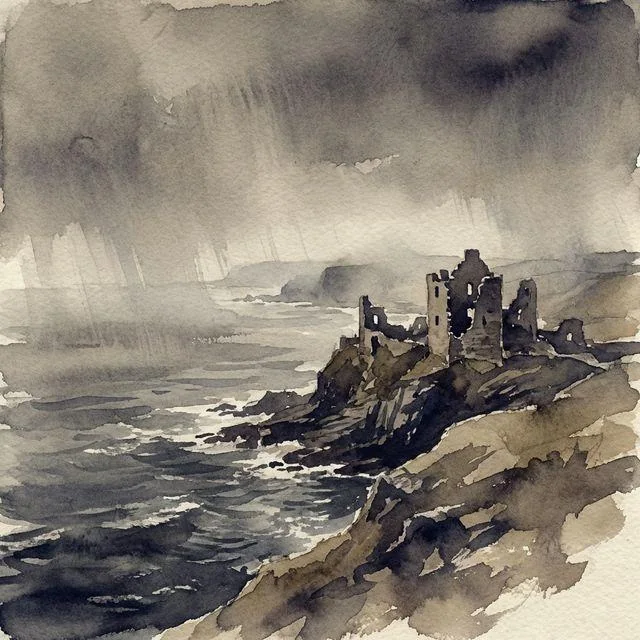
Castle Sinclair Girnigoe stands on a narrow promontory of cliff three miles north of Wick, on the Caithness coast. The sea surrounds it on three sides. It has been a ruin since the late seventeenth century. The Clan Sinclair Trust has been engaged in its preservation since the 1990s.
The castle contains a feature noted in the architectural record as the laird’s lug — a concealed chamber positioned above the great hall, designed to allow whoever occupied it to hear conversations taking place in the room below without being seen. Its existence is a matter of structural fact, not tradition. It is built into the castle. It was built there deliberately.
What was heard from it, and by whom, is not recorded.
In 1577, George Sinclair, 4th Earl of Caithness, imprisoned his son and heir, John Sinclair, Master of Caithness, in the vaults of Castle Girnigoe. The stated reason was suspicion of rebellion. John Sinclair was held there for seven years.
In the final period of his imprisonment, his father arranged for him to be fed salted beef. No water was provided. No other drink of any kind is recorded as having been permitted.
John Sinclair, Master of Caithness, died in the vaults in 1578. The historical record notes that by the time of his death, he had lost his reason. The mechanism of his death was thirst.
The castle sits on a promontory surrounded on three sides by the North Sea.
This fact appears in no account consulted for this record as requiring comment. It is not remarked upon in the historical sources. It is included here because, on reflection, it seems worth remarking upon.
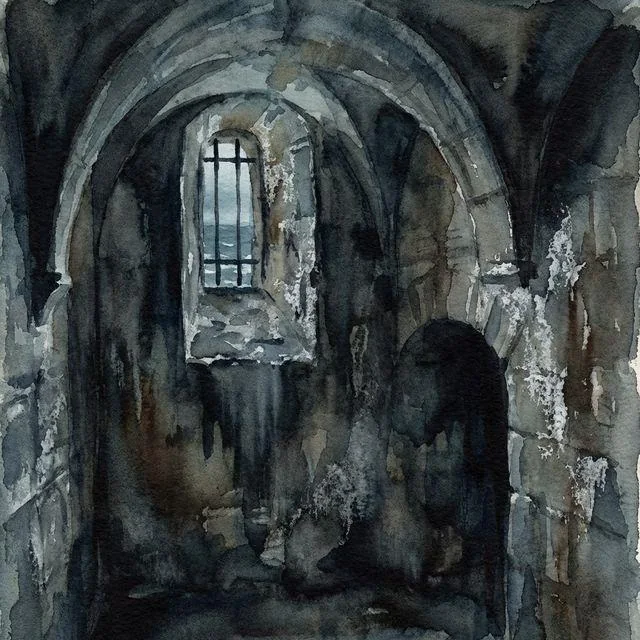
The castle kitchen contains a feature noted in Robert Sinclair’s architectural description of Girnigoe: a small secret chamber in the vaulted ceiling. The chamber’s purpose has not been established. It is not a laird’s lug — that feature is located elsewhere in the structure. It is not a storage space in any conventional sense. Its position, in the ceiling vault directly above the kitchen floor, is not consistent with any standard domestic or defensive function identified in the literature consulted for this account.
What it was used for is not recorded.
Whether anything was kept in it, placed in it, or used to hear what was happening below has not been determined.
It is noted here because it is there, because its purpose remains unresolved, and because the castle already contains one room built specifically for listening without being known to be listening.
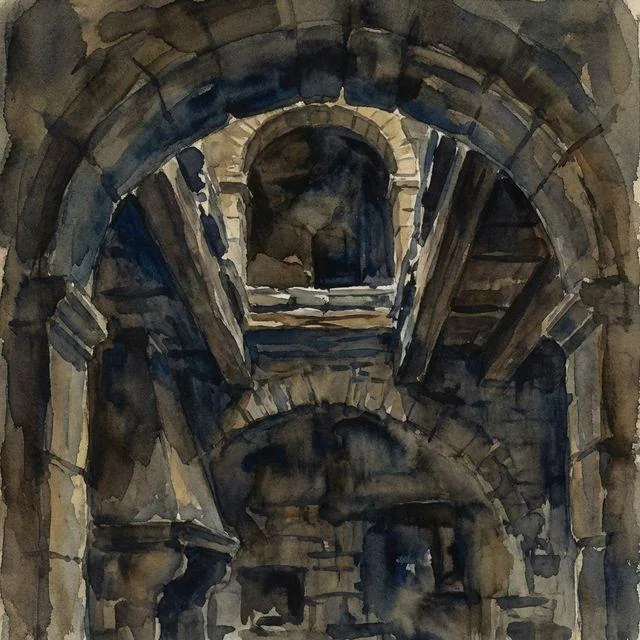
The accounts gathered from visitors to Girnigoe do not describe apparitions. They do not describe figures, light, or movement.
They describe sound.
Specifically: a sound described across independent accounts as a dry, repetitive, and rhythmic noise heard within or near the lower sections of the castle. The accounts do not agree on its precise character. Several describe it as knocking. Several describe it as scratching. One account, submitted in writing to a paranormal research organisation and dated 2019, describes it as the sound of someone running their tongue across stone.
The person who submitted that account does not elaborate. The description is given plainly, without evident attempt at effect, and the account moves on.
The vaults in which John Sinclair was held are accessible to visitors. The space is low, and the walls are close, and the sound of the sea is constant — present through the stone as a vibration as much as a sound, so that the rock itself seems, in certain conditions, to be conducting something.
Whether that quality is responsible for what visitors report, or whether it is simply part of what the space is and has always been, is not a question this account can resolve.
What is recorded is this: that a man died of thirst in these vaults, slowly, over a period of days, within sight of the sea through whatever aperture the stone permitted. That the castle was built to hear things. That there is a space in the ceiling of the kitchen whose purpose has not been established. That the sound reported in the lower levels is dry.
The accounts do not agree on its source.
They do not attempt to explain it.
No record confirms the accounts described.
The castle remains standing.