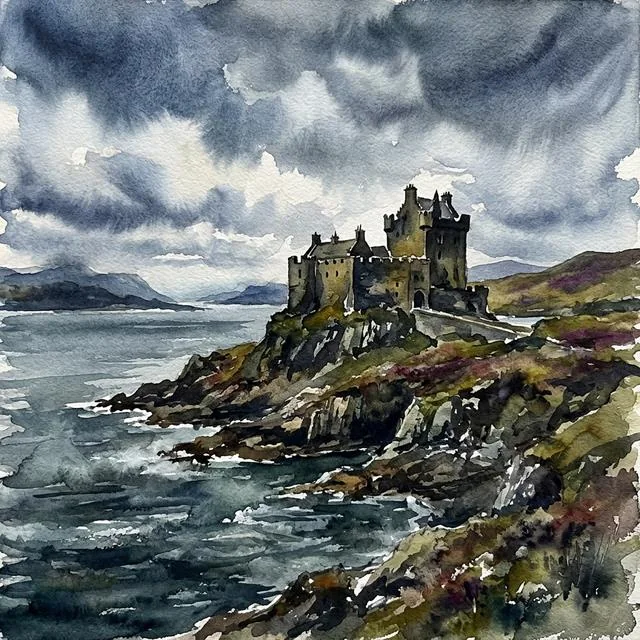
Duart Castle stands on a promontory at the eastern tip of the Isle of Mull, its walls rising from black rock above the Sound of Mull. The castle has been the seat of Clan Maclean since the fourteenth century. It fell into ruin in the eighteenth century and was restored by Colonel Sir Fitzroy Maclean from 1911. It remains in the clan's ownership and is open to the public.
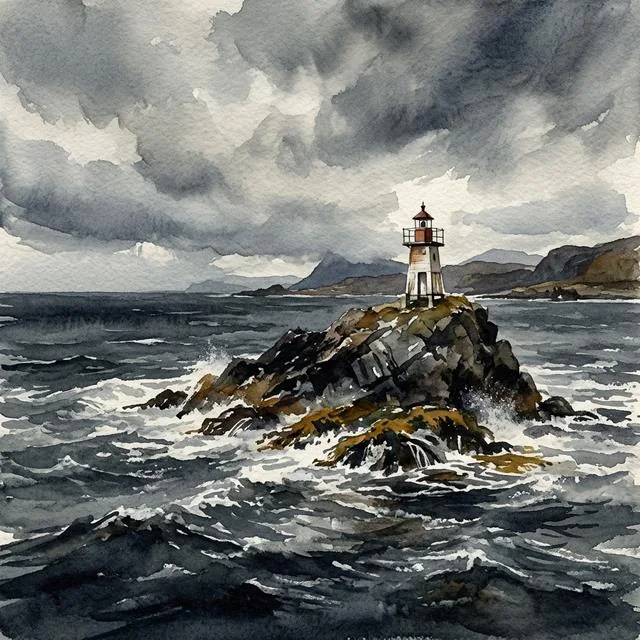
From the seaward windows of the keep, a small skerry is visible in the channel to the south-west. It is submerged at high tide. It carries a navigation beacon. It is called Lady’s Rock.
The name comes from what Lachlan Cattanach Maclean, 11th Chief of Clan Maclean, did there in the early sixteenth century.
In approximately 1520, Lachlan Cattanach married Catherine Campbell, sister of Archibald Campbell, Earl of Argyll. The marriage produced no male heir. According to the historical record, Lachlan resolved to dispose of his wife.
He rowed out to the rock at night, at low tide, and left her there. He returned to the castle. In the morning, he looked out from the keep toward the rock.
It was empty. The tide had covered it.
He sent word to the Earl of Argyll that his sister had died.
He subsequently accepted an invitation to dine at Inveraray Castle, the Earl’s seat, and arrived with his retinue. He was taken to the great hall. Catherine Campbell was seated at the high table, beside her brother.
She had been rescued during the night by a passing boat.
No word was said of the incident by the Earl, by Catherine, or by any member of the Campbell household. Lachlan Cattanach was permitted to leave. He was murdered in his bed in Edinburgh in 1527 by Sir John Campbell of Calder, Catherine’s brother.
The sequence is recorded in the historical sources and is not disputed in its principal details.
What is noted here, separately from the historical record, are the accounts gathered from the seaward side of the keep.
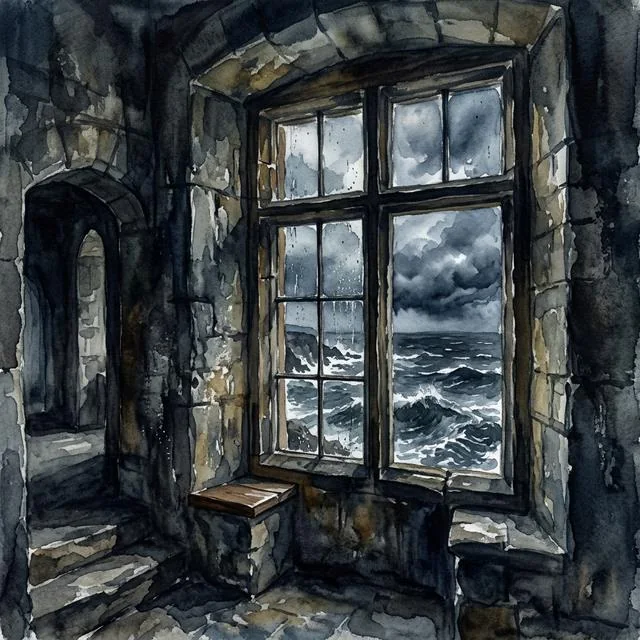
The window that looks out over Lady’s Rock is accessible to visitors. It is one of the windows from which the rock is visible at low tide and from which it is not visible at high tide ”” from which, on the morning after Catherine Campbell was left there, Lachlan Cattanach looked out and saw nothing.
Accounts gathered from this part of the castle describe cold air at the window that is not consistent with the ambient temperature of the room. They describe it as localised ”” present at the window, absent two feet behind it. Several describe it as the cold of air coming off water, though the window is closed and the sea is some distance below.
These accounts are not numerous. They have not been gathered systematically. They appear in visitor records, in correspondence submitted to the castle, and in accounts given informally to staff. They are consistent in their location and in their description of the cold.
They are not consistent in anything further. No figure is described. No sound is reported. The accounts describe cold air at a window that looks out over a rock, and nothing else.
Catherine Campbell, after the events described, returned to her family at Inveraray. What she did in the subsequent years is not recorded in detail in any of the sources consulted for this account. Whether she looked out from any of Inveraray’s windows toward Mull is not recorded.
The Earl of Argyll waited. The invitation was issued in due course. The method he chose was a bed, at night, and a man sent in darkness ”” the same conditions in which his sister had been left on the rock.
The rock is named for her. The castle is named for no one.
Lachlan Cattanach saw the empty rock from the window and believed what he saw.
What he did not see ”” Catherine Campbell, in the dark, in the water, being taken off the rock by unknown hands ”” is not recorded as having disturbed him. He sent his message of condolence with apparent confidence.
Visitors to the window look out at the same view. The rock is visible at low tide: a low dark shape in the channel, carrying its navigation beacon, submerged and invisible when the water rises.
The cold at the window has been reported when the rock is visible and when it is not.
The window remains.
The view has not changed.