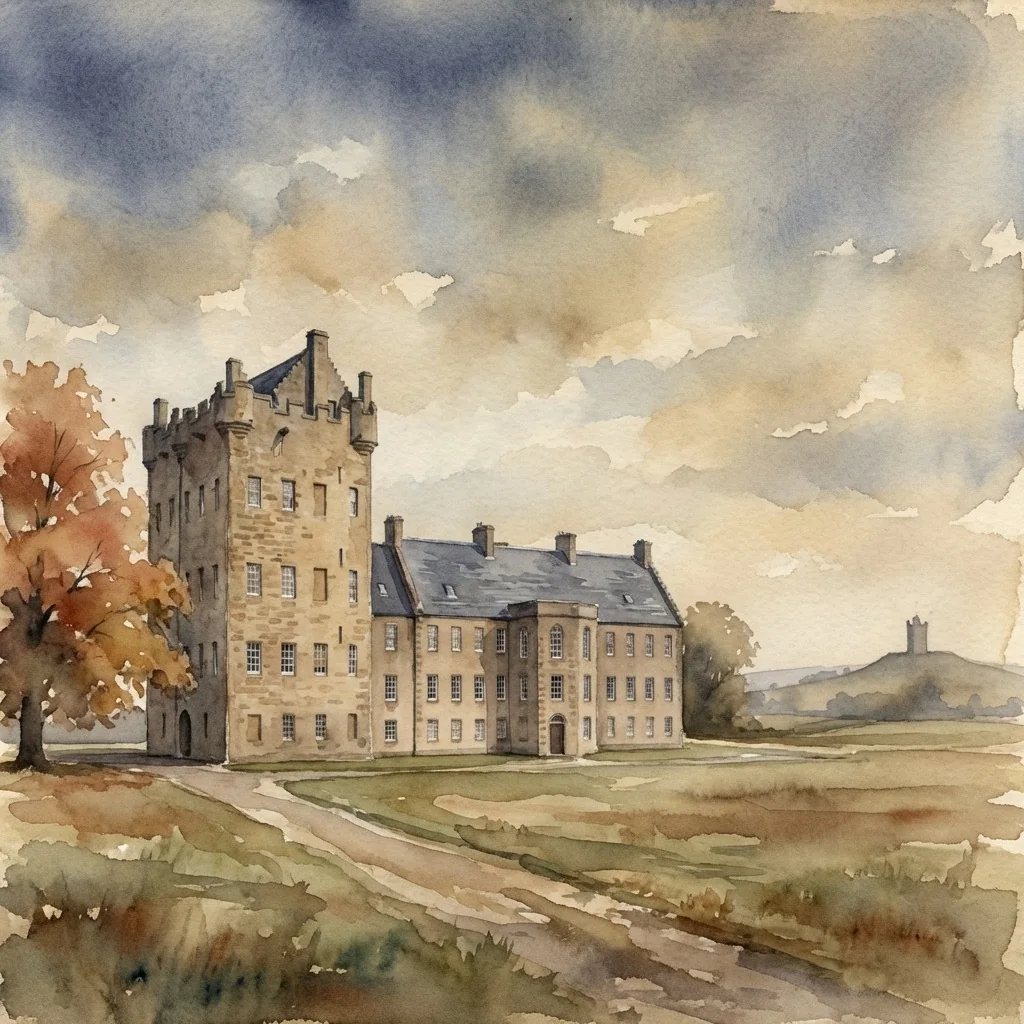
Rising proudly above a great sweeping canopy of ancient trees, the formidable medieval stonework of Alloa Tower once seamlessly met an extraordinarily grand, bustling mansion. Before the tragic fire of 1800 that claimed the magnificent adjoining house, leaving only the ancient tower standing in quiet isolation, the Alloa Estate was widely known as a vibrant, welcoming residence. But the fire left more than ruins in its wake.
It left behind something that would be spoken of for years after.
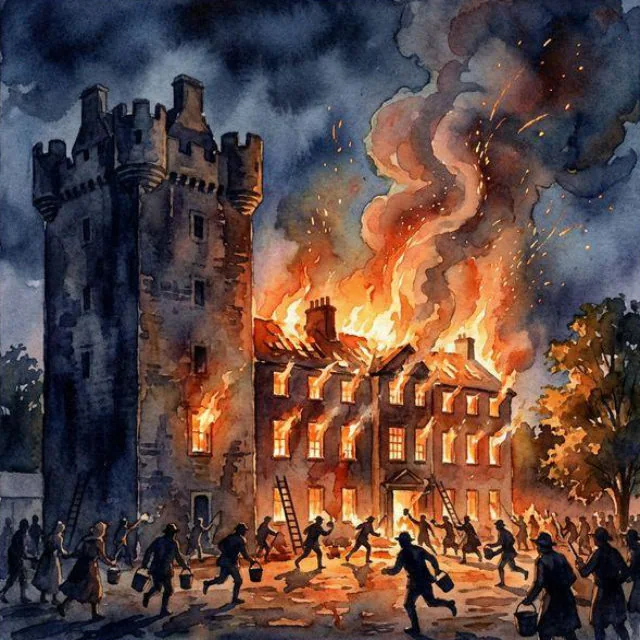
The fire started in the east wing sometime around midnight.
Nobody ever agreed on exactly when, or exactly how. The servants said a candle. The groundskeeper said he'd smelled smoke as early as ten o'clock, drifting from somewhere beneath the floors, somewhere deep and structural, as though the house had decided to consume itself from the inside out. Later — much later, when there was nothing left of Alloa House but blackened sandstone teeth and a smell that would cling to the valley for weeks — people would stop trying to explain the origin of the fire and start instead talking about what had been seen during it.
They talked about the lady with the green lantern.
The following account was given by Thomas Rennie, aged seventeen.
Thomas Rennie was seventeen in 1800, a stable boy who'd worked the Erskine estate for two years. He was the first one out of bed that night, woken not by smoke or the sound of breaking glass but by something he couldn't easily name. A feeling, he would say later, like someone had leaned down and breathed cold air directly into his ear.
He stepped into the courtyard in his shirtsleeves and saw the upper windows of the east wing glowing amber. For a moment, half-asleep, he thought it was only candlelight. Then the candlelight moved, and grew, and a portion of the roof exhaled a long, slow column of sparks into the July sky.
He started shouting.
But before the others came — before the bells and the buckets and the terrible percussion of the collapsing upper floors — Thomas saw her.
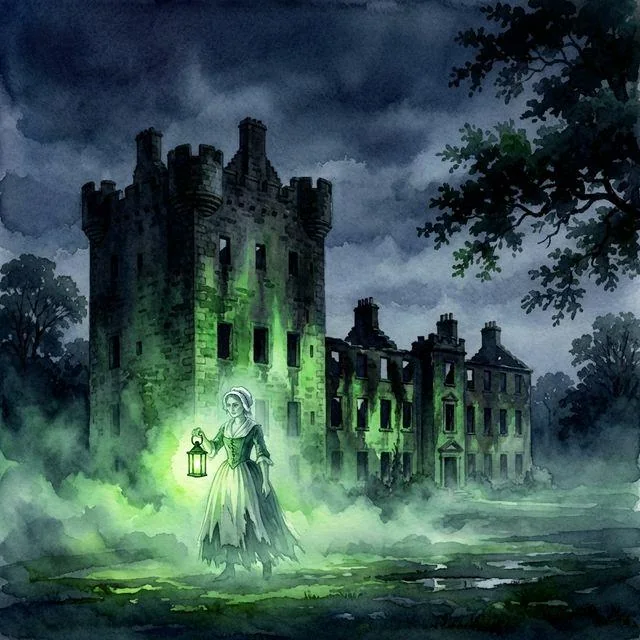
She was on the far side of the courtyard, standing quite still at the edge of the formal garden, holding a lantern at her side. The lantern burned green. Not the sickly yellow-green of a flame seen through coloured glass. A deep, self-contained green, the colour of water at the bottom of a well, as though it showed something, rather than lit it. The lady was dressed in clothes that Thomas would later struggle to describe — old-fashioned, he'd say. Like a portrait. Like something from before.
She was looking directly at him.
"I called out," he told the magistrate who took his statement, three days after the fire. "I said hello, or are you all right, something of that sort. She didn't answer. She only—" He paused. "She lifted the lantern. Held it up, like she was showing it to me. And then she turned and walked toward the tower."
By then, the others were pouring into the courtyard. Thomas was swept up in the chaos — the screaming, the desperate relay of leather buckets from the well, the noise of the fire, which had its own voice, low and continuous and almost patient. He didn't see the lady again.
He assumed she'd been a guest. He assumed someone else would mention her.
No one did.
Margaret Duthie, who had worked in the kitchens for eleven years, was a practical woman who distrusted gossip the way she distrusted unset custard — it was always liable to make a mess. She'd heard Thomas's account and called it the imaginings of a frightened boy. She'd said as much to anyone who'd listen.
She stopped saying it after her own experience, which came not on the night of the fire but three weeks later, once the ruins had cooled, the family had decamped, and a kind of awful silence had settled over the estate.
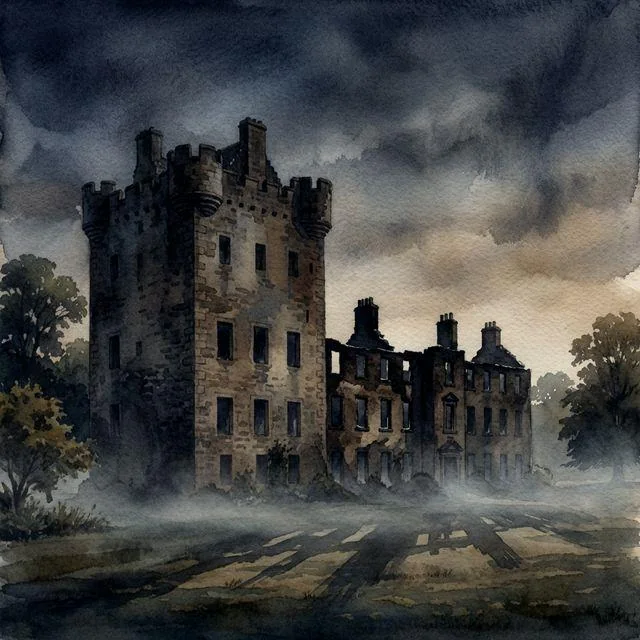
She'd come back to retrieve something. A small thing, a piece of her own property she'd left behind in the chaos. It doesn't matter what it was. What matters is that she walked across the courtyard in the late evening — the sky still light, that long midsummer gloaming that makes the Scottish evening feel suspended, unreal — and she passed close to the ruins of the east wing, and she heard footsteps on the stone.
She stopped.
The footsteps stopped.
She walked on. The footsteps resumed, slow and even, coming from somewhere inside the roofless shell of
the house. She turned. The walls stood open to the sky, their windows empty as pulled teeth. And there,
at what had once been the first-floor window of the blue drawing room, stood a figure holding a green
light.
It was looking at her.
Margaret would say, for the rest of her life, that the worst part was not the figure, and not the light. The worst part was the expression on its face. She couldn't have said, at that distance, how she was so sure she understood it, but she was. She'd stake everything on it.
The figure looked satisfied.
The Erskine family rebuilt, eventually. Not the mansion — that was gone, its stones carted away or left where they fell — but their lives, their fortunes, their arrangements. The tower remained, as it had always remained, indifferent to everything that happened around it. It had stood for centuries before the house was built. It would stand for centuries afterward.
And now and again, down the years, someone would mention the lady. A figure in the grounds late at night. Green light in the ruins. Always still. Always watching. Always, somehow, communicating that particular expression that Margaret Duthie could never quite put into words.
Satisfied.
As though she'd been waiting for something to happen, had waited a very long time, and had finally — on a hot July night in 1800, in the amber chaos of a burning house — gotten what she had been waiting for.
Nobody ever learned who she was. Nobody ever established whether the old records of the Erskine family contained any portrait that might have matched Thomas Rennie's halting description.
The tower keeps its secrets.
It always has.
No official record identifies the woman described in these accounts.
Alloa Tower remains standing.