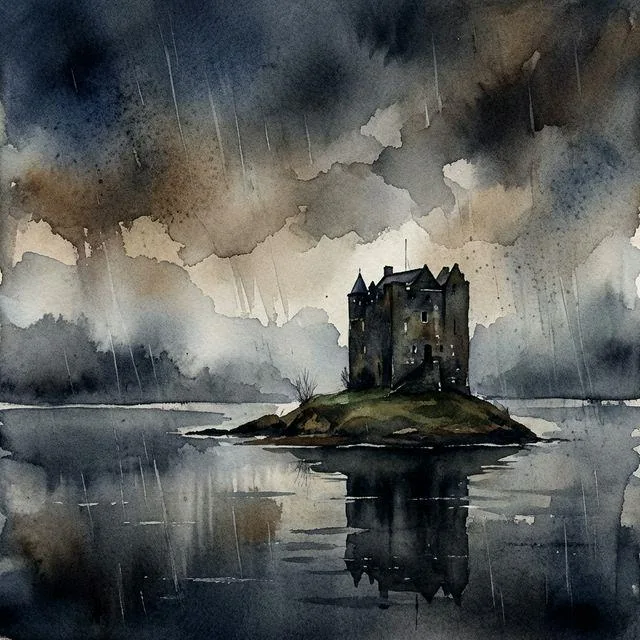
Dusk came early to Loch Laich in November, the hills swallowing the last of the light before five o'clock, the water going flat and black between the shore and the island. From the window of the inn at Portnacroish, a man could watch the castle become a silhouette, and then a darkness within darkness, and then nothing at all — just the sound of the loch moving in the cold, and the faint outline of the tower against a sky that was never quite fully dark this far north, winter or no.
Ewan Maccoll had watched it every evening for three weeks. It was not, he had come to feel, a comfortable thing to watch.
He was a clerk by trade, sent up from Edinburgh in the autumn of 1701 to settle a minor dispute over land boundaries between the Campbells of Airds and the Stewarts. The work had taken longer than expected — it always did, when Campbells and Stewarts were involved — and the weather had closed in, and now he was lodged at the inn with his papers and his ledgers and a landlord who spoke more Gaelic than Scots and regarded him with the particular wariness reserved for men who arrived with documents.
It was the landlord who first mentioned the light.
He'd done it obliquely, the way men in that country approached things they found difficult to say plainly. Something about the castle's history. The Stewarts losing it in 1620 — the seventh chief, Duncan, drinking himself into a wager with the Campbells and losing the whole island on the turn of a card, or the roll of a dice, depending on who was telling it. The Stewarts getting it back eventually, after a siege, but that wasn't the point. The point, the landlord said, was that the castle remembered everything. It had a long memory, that tower. Longer than any of the men who'd lived and died in it.
And then, carefully, as though the words had been waiting: there are those who have seen a light above it. Before a death in the Stewart line. A ball of light, bright as a lantern, that hangs over the tower and then goes out.
Ewan had entered it in his notebook as local superstition.
That was before the third week.
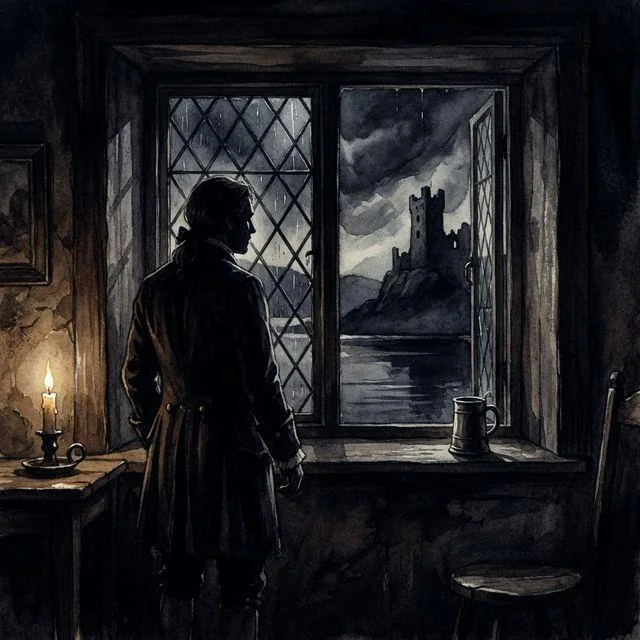
He saw it on a Tuesday, just after eight in the evening.
He'd been at the window with a cup of something the landlord called whisky and that Ewan privately considered a punishment. The loch was invisible, the night overcast, the castle gone entirely into the dark. He was thinking about Edinburgh. About his rooms there, his fire, the particular comfort of a city that did not watch you.
The light appeared without preamble.
It was above the tower — or above where the tower must be, in that absolute darkness. Spherical, self-contained, the size of a carriage lamp but with no flicker, no movement, no quality of flame about it whatsoever. It simply was. A cold, brilliant, perfectly still light, hanging in the air above the island as though it had always been there and was merely choosing, tonight, to be seen.
Ewan set down his cup.
He watched it for what felt like a long time. The light did not move. It did not pulse or dim. It hung with the patience of something that had no concept of weather, or cold, or the passage of hours. He had the distinct and unnerving sense that it was not for him — that he was witnessing something that would have happened whether he was at the window or not, something that had nothing to do with observers. A private signal, passing between the castle and whatever was being signalled.
He went to wake the landlord.
By the time they returned to the window, the light was gone.
The landlord looked at the empty darkness over the water for a long time. He said nothing. His expression was not sceptical — that was the thing Ewan would remember longest. There was no polite doubt in it, no suggestion that the clerk from Edinburgh had been deceived by the dark. He looked at the empty sky above the island the way a man looks at a wound he has been expecting.
Someone in the Stewart line, he said finally. Someone has died tonight, or will soon.
Ewan wrote it down. He wrote down the time, the duration, the approximate position in the sky. He was a clerk. He dealt in facts.
He returned to Edinburgh in December and in January heard, in passing, that Iain Stewart of Appin had been found dead on the hillside above Loch Linnhe, cause unclear, the ground too frozen to have told any story even if the ground had been inclined to. He was the younger brother of the current chief. He had been, by all accounts, a healthy man of forty-two with no enemies that anyone would name aloud.
Ewan retrieved his notebook. He compared the dates.
They matched.
He sat for a while at his Edinburgh desk, in his Edinburgh rooms, with his Edinburgh fire crackling at his back. Then he closed the notebook and put it at the bottom of a drawer and covered it with other papers, the way you cover something you are not ready to examine. He told himself there was nothing remarkable in a coincidence. He told himself that lights over water had explanations — gas, reflection, the tricks that cold air played on distant flames.
He told himself this for the rest of a long life.
He was never entirely persuaded.
No record confirms the account given by Ewan Maccoll.
Castle Stalker remains.