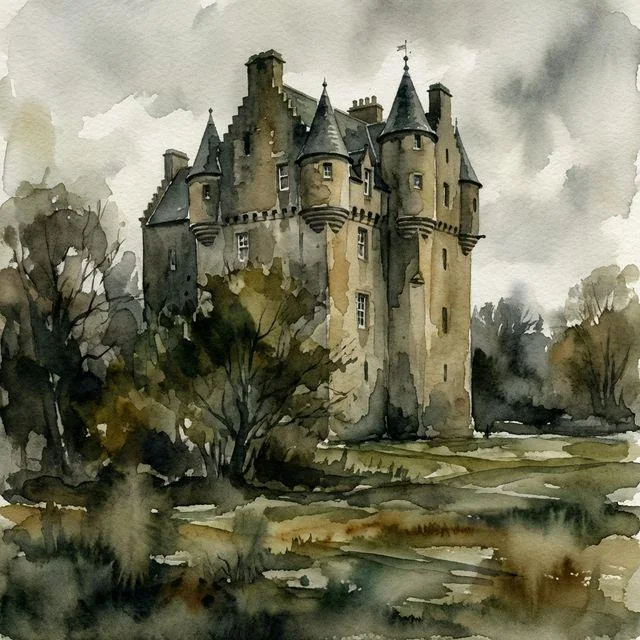
Crathes Castle stands near Banchory in Aberdeenshire, on land granted to the Burnett family by Robert the Bruce in 1323. The tower house was begun by Alexander Burnett of Leys in 1553 and completed in 1596. It passed to the National Trust for Scotland in 1952 and is open to the public.
One of the upper rooms is known as the Green Lady’s Room.
The name predates the nineteenth-century renovation work. It predates the lifting of the hearthstone.
It comes from the accounts.
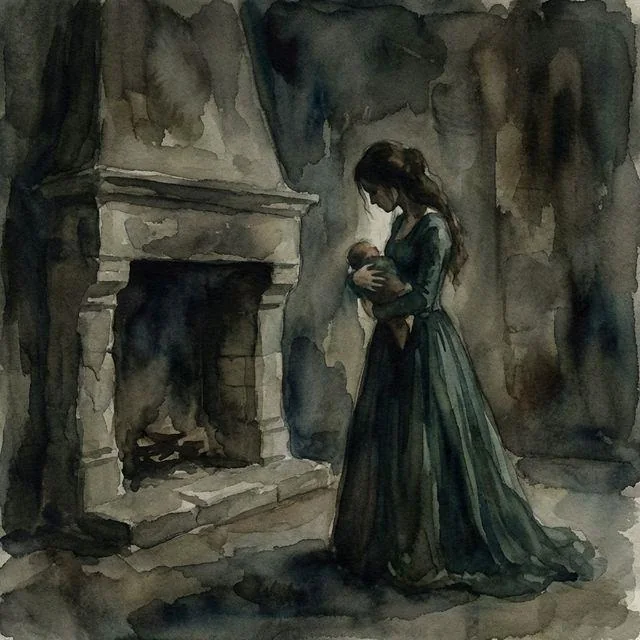
The figure is described consistently across accounts gathered from the castle over several centuries. A young woman in a green dress, carrying an infant. She is seen at the fireplace. She is standing there, or moving toward it, and then she is not there.
The accounts do not describe her looking at anyone. They do not describe her acknowledging the other occupants of the room.
They describe a woman at a fireplace, holding a child, and then her absence.
The corner of the room does not vary.
Queen Victoria is recorded as having seen the figure during a visit to Crathes. Her account describes a green mist forming into the shape of a woman carrying a child, moving toward the fireplace, and disappearing.
At that point, the hearthstone had not been lifted.
During nineteenth-century renovation work, the hearthstone of the fireplace was removed.
Beneath it were bones.
The remains of a woman and an infant.
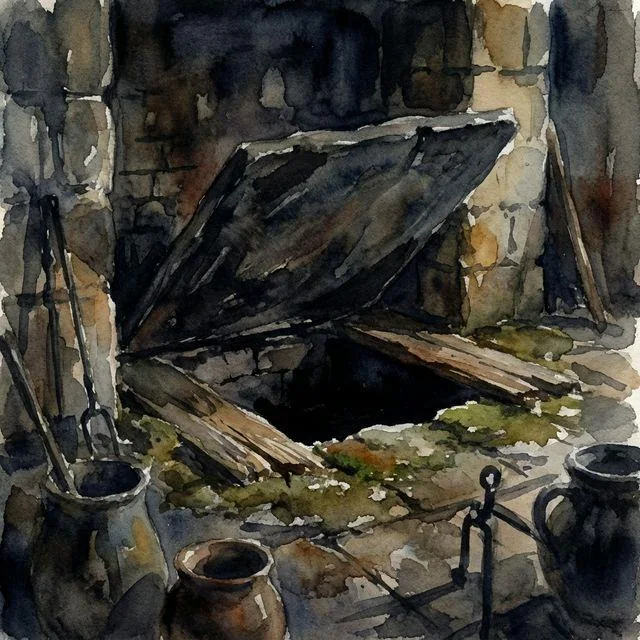
No identification was made. No record has been located that establishes when the remains were placed there, or under what circumstances.
What is recorded is their position.
They were beneath the hearthstone.
They were in the corner of the room where the figure had been reported to have stood.
After the discovery, the accounts continued.
The description does not change. A woman in green, carrying an infant, is at the fireplace. She stands there, or moves toward it, and then she is not there.
The accounts before and after the discovery describe the same figure in the same place.
Several explanations have been attached to the remains. None are established. No name has been confirmed.
What is established is the sequence.
The figure was reported in the room.
The room was named for the figure.
The hearthstone was lifted.
The remains were found where the figure had always been seen to stand.
The room remains open to visitors.
The fireplace remains in place.
The corner of the room has not changed.
The accounts have not changed.
She stands at the hearth.
She holds the child.
She does not look up.
No record explains the correspondence between the accounts and what was found.
The room remains.