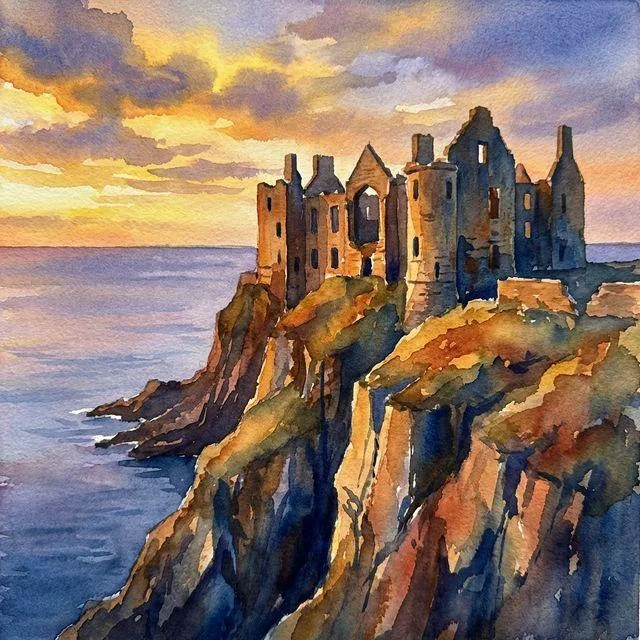
The following account is drawn from Boswell’s visit to Slains Castle in September 1773, during his tour of Scotland with Samuel Johnson. While his published journals make no reference to the events described here, later notes suggest he did not sleep well in the room he described as “most elegant.-
Boswell had been warned about the pillows.
Not in so many words — no one had sat him down and said don't sleep on those pillows, Mr Boswell, don't close your eyes in that room — but looking back on it later, the housekeeper had hesitated when she showed him in. Just a half-second pause at the threshold, lamp held out, before she stepped aside to let him through. He had put it down to the hour. He had put a great many things down to the hour.
It was late September, 1773. He and Johnson had spent the evening in the great hall as guests of the Countess, the fire enormous, the conversation brilliant and raucous, Johnson holding court the way Johnson always held court — like a bear that had been taught philosophy and was rather pleased with itself. They had drunk well. Boswell had drunk better than well. He climbed to his room in high spirits and stood at the window looking out at the North Sea, black and enormous, flinging itself against the base of the cliff with a sound like distant artillery. The castle walls, at this corner, seemed to be the cliff. There was no boundary between dressed stone and naked rock, just a seamless vertical drop to the churning dark below.
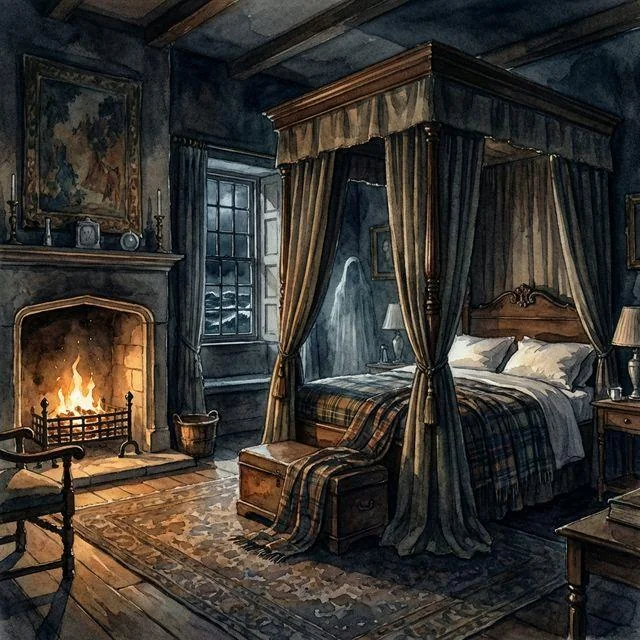
A most elegant room, he would write. And it was — the furniture rich, the fire already blazing, a decanter set out on the side table. He poured himself a measure, toasted Johnson's health in absentia, and went to bed.
The smell reached him before sleep did.
Something about the pillows. A low, marine smell, something that didn't belong indoors — seabird feathers, he realised, packed inside the ticking, and the salt and fish-stink of the things had permeated the linen so thoroughly that lying down was like pressing his face to a harbour wall. He turned onto his back. The fire spat. The sea roared. He stared at the ceiling and felt sleep recede from him like a tide going out, and in the restless half-dark between waking and dreaming he found himself thinking of Lord Kilmarnock.
William Boyd, Fourth Earl of Kilmarnock. The name arrived in his mind with the clean inevitability of something remembered rather than imagined. He had married into the Erroll line, had fought for the Pretender in the '45, and had paid for it the following year on Tower Hill, the axe making its argument in the morning of a London August. Twenty-seven years ago. Not so long, really. Not so long at all.
Boswell was not a fanciful man. He was a lawyer, the son of a judge, a man who trafficked in evidence. He told himself this as the fire burned lower and the shapes in the room began to do what shapes do in firelight — shift and breathe and rearrange themselves at the edges of vision. He told himself this quite firmly.
It didn't explain the cold.
It came from the window side of the room, a steady and sourceless cold that was quite distinct from the draught off the sea — not moving air but still air, cold in the way that deep water is cold, cold as a thing that has been that way for a very long time and sees no reason to change. Boswell pulled the blankets up. The fire was still burning. The cold was indifferent to the fire.
He heard footsteps in the corridor.
Slow, even, unhurried — the footsteps of someone who knew the house well and had no particular urgency. They stopped outside his door.
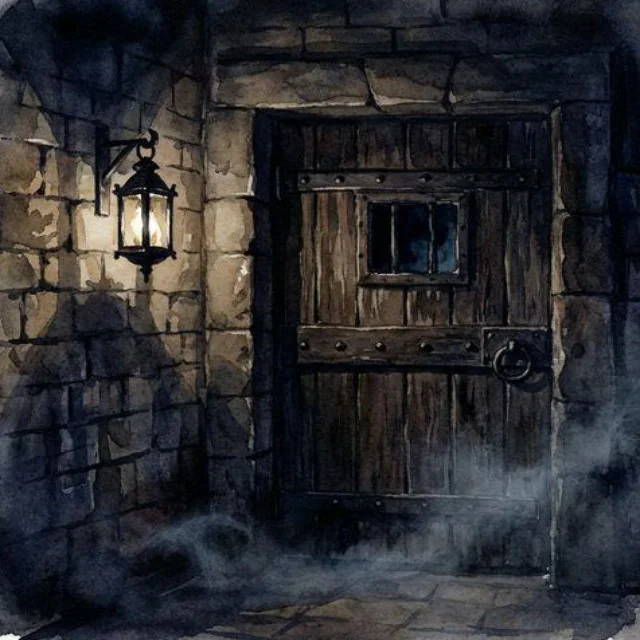
He lay absolutely still.
The door didn't open. Nothing came in. But the silence on the other side of it had a quality he couldn't name — a listening quality, a silence that was paying close attention. The cold in the room deepened. On the pillow beside him, the one he hadn't been using, he became aware — with a certainty that arrived without any sensory evidence he could point to — that he was not alone.
He did not look.
That was the thing he would never write down, not in the Tour, not in the journals, not in any letter to any friend. He had lain in that elegant room at Slains with the sea roaring below and the fire dying in the grate, and he had felt, with absolute conviction, that something sat on the edge of the bed. And he had not looked. He had shut his eyes and pulled the blankets to his chin like a child and listened to the fire settle and the sea batter the rocks and waited, with a terror that shamed him to remember, for the darkness to become ordinary again.
By the time the grey Aberdeenshire dawn reached his window, the cold was gone.
He rose and dressed and went down to breakfast and said nothing. Johnson, across the table, was in magnificent form — praising the castle, praising the Countess, praising the Scots in general with the generous amplitude of a man who had slept like the dead.
"Well, Boswell," he said. "How did you sleep?"
"Tolerably," said Boswell. "The room was most elegant."
He reached for the bread. His hand, he noticed, was not entirely steady.
Later, packing to leave, he glanced back at the room from the doorway. Daylight filled it now, plain and cold and ordinary. The bed was made. The pillow he had not used was smooth and undisturbed.
He told himself it had been the whisky. The fire, the sea, the smell of those damned feathers. A man's imagination, working in the dark.
He almost believed it.
No record of the night appears in Boswell’s published journals.
Slains Castle remains.