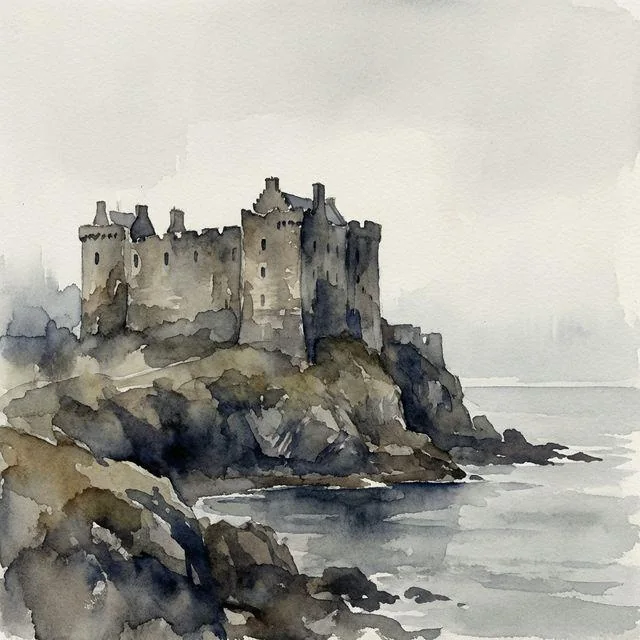
Dunstaffnage Castle stands on a promontory at the mouth of Loch Etive, three miles north of Oban. Built in the thirteenth century by the MacDougalls of Lorn, it has been held by the Campbells since 1470. The castle and its nearby chapel are scheduled monuments and open to the public.
There is a condition attached to the office of Hereditary Captain of Dunstaffnage. The holder of the title is required to spend a minimum of three nights each year in the sixteenth-century gatehouse. The gatehouse is simple. It is also, by the account of more than one occupant, not empty.
No record establishes a connection between these conditions and the accounts that follow.
The figure known as the Ell-maid of Dunstaffnage has appeared in local oral tradition for as long as the castle’s records extend. Accounts describe a woman in green, seen on the ramparts or within the castle walls. The expression recorded varies. Those who have seen her weeping have reported that misfortune followed — for the Campbell family, for the castle’s keepers, for the wider household. Those who have seen her smiling have reported good fortune in the same measure.
A smaller number of accounts describe a different expression.
Several accounts, preserved in sources not widely circulated, describe encounters in which the Ell-maid’s expression was neither grief nor happiness. The word used is consistent across accounts, with no apparent connection between them.
The word is waiting.
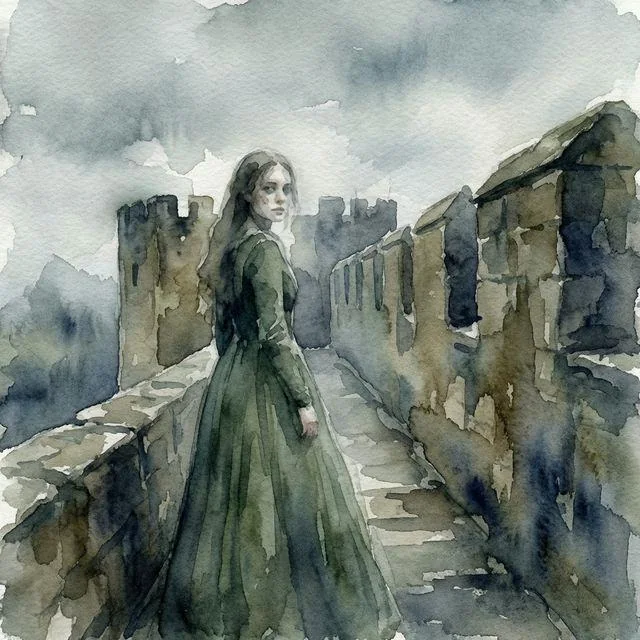
The most detailed account in this category was recorded by a minister named Archibald Gillies, who visited Dunstaffnage in the autumn of 1887 in connection with research into West Highland folklore. His notes, held privately, were made available for the preparation of this account. They describe an evening walk along the castle’s wall-walk, during which Gillies observed a figure standing at the north-western tower.
He took it for another visitor.
She was quite still, he writes, in a way visitors are not. People who have come to look at a view shift their weight, turn their heads. She did not move at all. The green of her dress was very distinct against the still-light sky. I called out. She did not respond. When I had crossed to within perhaps twenty feet of her, I saw her face clearly.
It was not grief, nor was it happiness. It was the face of someone who had been waiting for a very long time.
I stopped walking.
She looked at me for a moment longer — looked at me, I am certain, not through me — and then she was not there.
Gillies makes no further comment on the sighting itself. The following entry in his notes, dated the next morning, concerns the chapel.
The chapel at Dunstaffnage stands a short distance from the castle, in a wooded hollow, its thirteenth-century walls now open to the sky. It contains the Campbell burial aisle, dated 1740, and the remains of what was once a richly decorated interior. It is now a quiet place.
On the afternoon of 20th December 1463, a wedding party walked the path between the castle and the chapel. The groom was Sir John Stewart of Lorn. He did not reach the door. A man named Alan MacCoul, who considered himself dispossessed of the MacDougall inheritance, had been waiting in the trees. Stewart was stabbed multiple times on the chapel path. He was carried inside, where he had sufficient strength remaining to speak his vows before he died at the altar.
MacCoul took the castle while the wedding guests were occupied with the dying man inside the chapel.
Gillies records that he sat in the chapel for some time on the morning after his sighting. He describes the light coming through the empty windows, the sound of the trees, and the names cut into the Campbell aisle. He does not describe anything unusual.
He notes, without elaboration, that the path between the chapel and the castle felt different on the return journey than it had on the way out. He could not specify how. He writes only that he was glad it was morning, and that he walked it quickly, and that he did not look back toward the trees.
The deep well in the castle courtyard has no established association with the Ell-maid or with any other reported phenomenon. It is mentioned here only because several independent accounts of visits to Dunstaffnage include a reference to it — not to anything seen or heard near it, but to a feeling described in terms that are difficult to distinguish from one account to the next.
Several accounts describe a persistent impression when standing at the well. The description varies, but the sense of presence below the surface is noted in several cases.
These accounts are not cited as evidence of anything. The consistency of the description is noted.
Flora MacDonald was held at Dunstaffnage in 1746, in the courtyard buildings, on her way to London for questioning over her part in the escape of Charles Edward Stuart following Culloden. She left no account of her time there that has survived. Whether she spent any of it looking into the well, or walking the ramparts, or crossing the path between the castle and the chapel in the trees, is not known.
Whether she saw anything is not recorded.
The Ell-maid has been reported at Dunstaffnage in every century since accounts began to be set down. The expression described varies. The figure does not.
The office of Hereditary Captain of Dunstaffnage continues. The condition of three nights annually in the gatehouse remains in force. The current holder of the title has not commented publicly on the experience.
The gatehouse floors are wooden.
The footsteps, when they come, are described as heavy.
No record confirms the accounts described.
The castle remains in use.