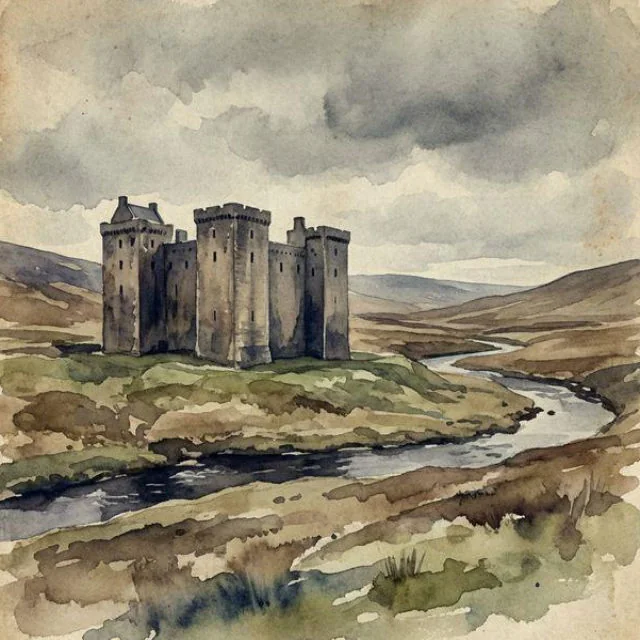
Hermitage Castle stands in the Hermitage Water valley in Liddesdale, six miles north of the English border. It has been a fortified site since the thirteenth century. The current structure dates principally from the fourteenth and fifteenth centuries. It is managed by Historic Environment Scotland and is open to the public.
The ground beneath it is considered, in the local tradition of the surrounding parishes, to be as significant as the structure above.
Sir Alexander Ramsay was appointed Sheriff of Teviotdale by King David II in 1342. The same year, Sir William Douglas, who had sought the appointment for himself, lured Ramsay to Hermitage and imprisoned him in the dungeon beneath the castle’s granary. Ramsay is recorded in historical sources as having survived for seventeen days. The means by which he survived — grain falling through cracks in the granary floor above — is noted in the same sources without elaboration.
He died in the dungeon. His groans are described in accounts gathered over several centuries. They are described as heard from below the floor, from within the lower dungeon space. They are described as faint, intermittent, and continuing long after any acoustic explanation would satisfy.
The accounts continue to be gathered.
Sir William de Soulis held Hermitage in the early fourteenth century. The historical record establishes that he was arrested for treason against Robert the Bruce in 1320 and died a prisoner in Dumbarton Castle the same year.
The tradition attached to him at Hermitage is of a different order.
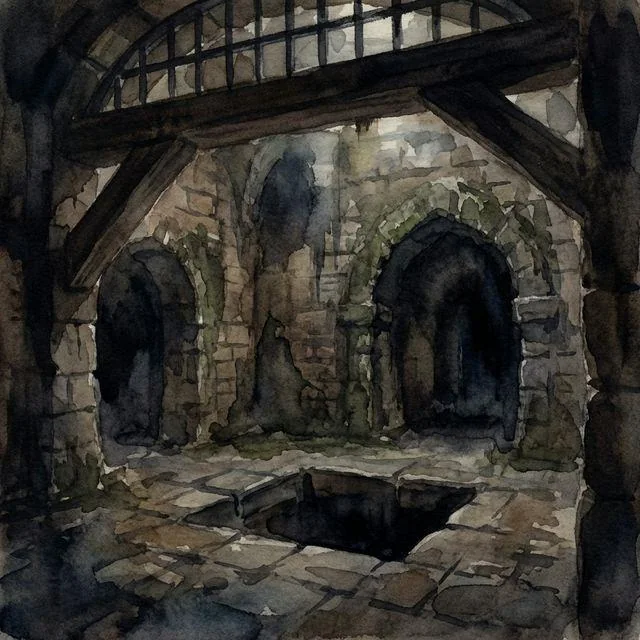
It describes a man who used the castle’s lower chambers for purposes not recorded in any document. It describes children taken from the surrounding district and not returned. It describes practices conducted in the vaults beneath the main structure — practices for which the oral tradition has many names, none consistent, all pointing in the same direction.
What is consistent across the accounts — across the ballad tradition, the border folklore gathered by collectors in the eighteenth and nineteenth centuries, and the visitor accounts gathered since the castle was opened to the public — is the direction in which these things are located.
Below.
Always below.
The local tradition recorded by Sir Walter Scott states that Hermitage Castle, unable to bear the accumulated weight of what had been done within it, began to sink into the earth. Scott records this without endorsing it, as a belief held by the people of the surrounding parishes. The belief was already old when he recorded it.
The castle has not visibly sunk. Its foundations are intact. It stands as it has stood for seven hundred years.
The tradition persists regardless.
W.T. Stead, the journalist and editor, visited Hermitage alone in the 1890s. He published an account of the visit in his journal Borderland in 1897. He describes unlocking the castle with a key borrowed from the keeper’s cottage and entering alone. He describes lying on the bank outside and giving himself over, as he puts it, to the atmosphere of the place.
He was startled, he writes, by a loud and prolonged screech from above him, followed by a sound he could only compare to trampling.
He attributes this, after reflection, to birds.
What he does not explain is an earlier passage in the same account, passed over without comment, in which he describes the silence inside the castle as having a quality distinct from ordinary silence. He does not elaborate. He moves on to the history of de Soulis and the border ballads.
The passage in question reads: there is something beneath this quiet that is not quiet.
He does not return to it.
The tradition regarding de Soulis specifies that he returns to the vaults every seven years. The source for this specificity is a border ballad of uncertain date. The line reads: when hollow opes the charmed door of chamber underground.
The chamber referred to has not been identified in any survey of the castle’s known substructure. Whether it corresponds to the dungeon in which Ramsay died, or to a further and deeper space below that, is not established.
No excavation has been conducted beneath the vaults.
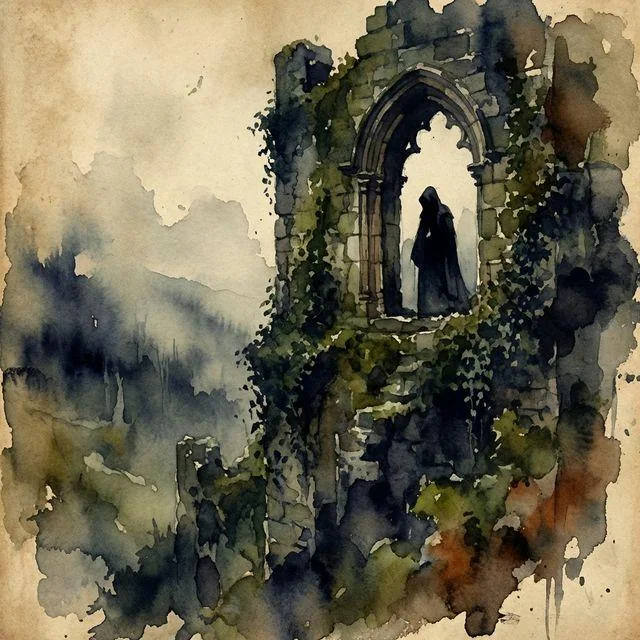
Figures have been reported in the upper windows of the castle — windows described in multiple accounts as inaccessible, the floors below them long since gone. The figures are reported as standing still, looking out.
They are not looking out over the valley.
The accounts that specify direction are consistent on this point.
They are looking down.
No record confirms the accounts described.
The castle remains standing.