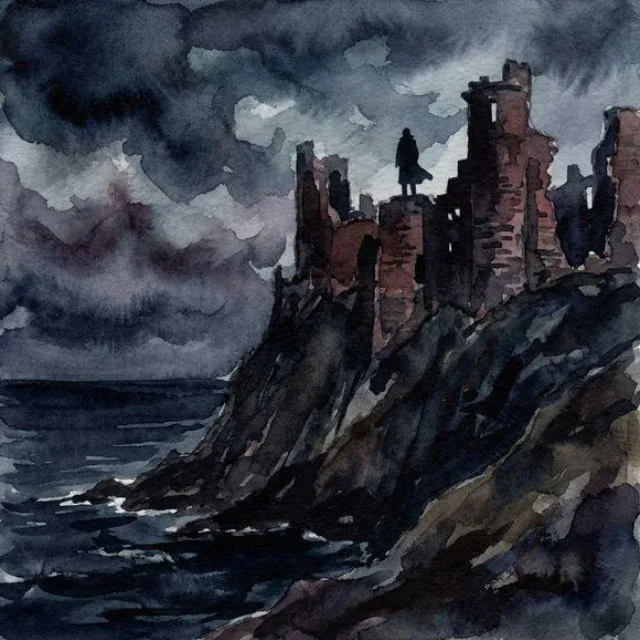
The soldier arrived at Tantallon on a Thursday in November, 1743, with a broken axle on his cart and nowhere else to go.
His name was Corporal James Weir, late of the 25th Regiment of Foot, and he was travelling the coastal road to Edinburgh with dispatches that were already two days overdue. The axle had cracked on a rut outside North Berwick, the weather was coming in hard off the Firth, and the only structure within walking distance was the castle on the headland — roofless, ruined, abandoned since the Douglas guns had fallen silent a century before. It was not an inviting prospect. But the wind off the water had teeth in it, and James Weir was a practical man.
He left the cart where it was and walked.
The gatehouse passage swallowed him whole.
That was how it felt — not that he walked through it, but that it took him in. The noise of the wind cut off so abruptly that his ears rang with the silence. He stood in the inner ward and looked up at the curtain wall, three sides of it still standing to a tremendous height, and the fourth side open to nothing, open to the sea, the rock falling away below in a sheer drop to black water. The sky was the colour of a bruise. Somewhere out beyond the headland, something was moving on the water, too dark and too large to be a fishing vessel. It was moving without lights, and it was moving slowly, as though it had no particular urgency about its destination.
He didn't look at it for long.
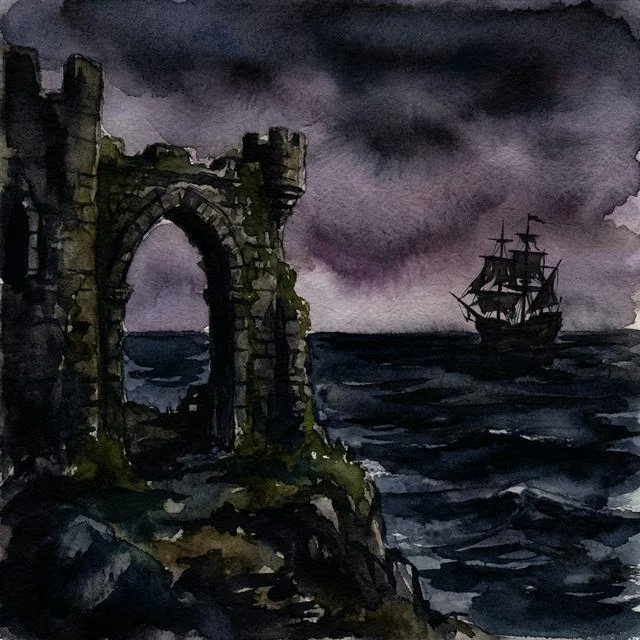
He found shelter in a corner of the ward where a section of fallen vaulting had created a low, cave-like overhang. He rolled himself into his coat, ate what little he had in his pack, and listened to the castle settle around him. Old stone has its own language. Tantallon spoke in deep ticks and slow exhalations, the sounds of weight distributed across centuries. James Weir had slept in worse places. He closed his eyes.
He woke to the sound of boots.
Measured, even, military — the footsteps crossed the ward from west to east, but angling, always angling, as though drawn toward the open fourth side, toward the drop and the black water beyond. They were the footsteps of a man who knew where he was going.
They stopped.
James sat up. The moon had broken through the overcast and the ward was bright enough to see clearly. It was empty. The grass, still and frost-touched. The great wall black against the sky. And beyond the open fourth side, the Firth — and on it, far out, that same dark shape, still moving without lights, still patient. Still there.
He waited.
The footsteps resumed.
He tracked them by sound — east to north, north toward the central tower, up what must have been the staircase, though there was no staircase anymore, nothing but a broken core of stone and a drop. And yet the footsteps climbed. He could hear them ascending, steady and patient, floor by floor, up through floors that no longer existed, and he sat with his back against the cold stone and his hand on the hilt of his short sword and did not move.
At the top — at whatever height the tower had once reached before time and cannon had settled the argument — the footsteps stopped.
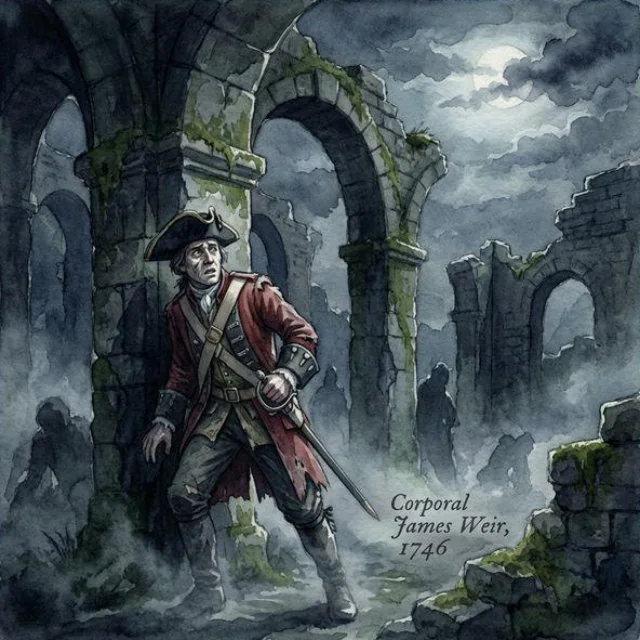
Silence. A long silence. Long enough that he began to think it had ended.
Then a voice, from up there in the empty air, said his name.
No one had spoken it since he’d left the road.
He told himself he had misheard. He told himself it was wind, the particular trick that coastal ruins played on sound, funnelling it and reshaping it until it resembled almost anything. He was a practical man. He had reasons for everything.
He did not sleep again.
At first light he was up and moving, and it was in the grey early morning that he saw the figure.
It was standing at the top of the central tower — or rather, at the top of what remained, a ragged stump of masonry perhaps thirty feet high, the uppermost edge broken and uneven, offering no flat purchase wider than a man's hand. No one could have stood there. And yet it stood. It was wearing a soldier's coat, old-fashioned, long in the skirt, a style James associated with the previous century, the wars of his grandfather's time. The wind was coming hard off the Firth, hard enough that James had to lean slightly into it, hard enough to make his eyes water. The coat did not move at all. Not the hem, not the cuffs, not the loosened collar. It hung as still as something painted.
The figure had its back to him, looking out to sea.
Out to where the dark shape on the water had been. Which was now gone.
He called up to it. His voice came back to him off the curtain wall, broken into pieces.
When he looked back at the tower, the figure was already facing him.
He couldn't see the face clearly. The distance and the light were against him. But he had the distinct impression — the absolute, bone-certain conviction — that it had been watching him all night. That it had known he was there before he'd even come through the gatehouse. That his arrival had been, in some sense he couldn't articulate, expected.
He left. He walked back down the road to his cart, found a farmhand willing to help with the axle, and reached Edinburgh by nightfall.
He filed his dispatches. He said nothing about Tantallon to anyone for nearly a year. When he finally told the story — in a tavern, to a man whose name he never caught — he included every detail except one.
The figure at the top of the tower.
When it had turned to face him, just before he'd looked away, he thought he'd recognised the coat. The cut of it, the particular arrangement of the buttons. It was the coat of his own regiment. Twenty-five years old if it was a day, weathered and salt-stained, the colour almost gone out of it — but his regiment's coat, unmistakably. He'd looked at the same coat in the mirror every morning for eleven years.
In all his years of service he had never known of a posting to Tantallon. No garrison record he had ever seen mentioned it. The 25th had no history there — none that was written down, in any case.
He never went back. He never entirely stopped thinking about it, either. About who had been stationed there, and when. About what that soldier had been watching for, out on the water, on a lightless November night.
About whether it had finally come.
No official record confirms the account given by Corporal James Weir.
Tantallon remains as it was.